
The Essence of Vision Engineering: Why Deep Learning Alone Cannot Drive Industrial Robots
The critical gap between 95% academic benchmarks and 99.99% real-world reliability. Exploring Mujin's multifaceted approach uniting geometry, optics, 3D point clouds, and physics models to conquer the 'last 5%'.
Modern computer vision heavily relies on deep learning, an approach that maps high-dimensional sensor data to desired outputs through neural networks. While deep learning has undeniably revolutionized object recognition and classification, in the physical world of industrial robotics, there are fundamental limitations that deep learning alone cannot resolve.
At Mujin, we reject treating mission-critical robotics as an uncontrollable black box. Instead, we practice a comprehensive discipline of Vision Engineering—uniting optical characteristics, 3D computational geometry, physics simulations, and domain-specialized machine intelligence software.
In this article, we explore the core challenges of computer vision in industrial robotics and explain why Mujin achieves over 99.99% continuous operational reliability by going far beyond pure deep learning models.
Deep Learning Alone
Data-Dependent Black Box
Excels at 2D categorization, but struggles with unmodeled pose variations, optical reflections, ambient disturbances, and physical deformation.
3D Geometry & Optics
Deterministic Physics-Based Verification
Real-time 3D point cloud alignment against CAD models, rigorous sensor calibration, and collision geometry guaranteeing millimeter precision.
Mujin Machine Intelligence
Hybrid Intelligence at Scale
Fuses deep learning’s perceptual generalization with 3D physical modeling to deliver 99.99%+ operational availability in demanding logistics hubs.
1. Limitations of Deep Learning in Industrial Robotics
Deep learning excels at recognizing objects and making probabilistic predictions within the distribution of its training datasets. However, inside real-world logistics fulfillment centers and high-speed factories, the robot’s task is never simply answering “what is in this picture?”
Instead, industrial robots must compute millimeter-precise 3D 6-DoF poses, verify the physical integrity of picking surfaces, compute complex collision avoidance with surrounding bins and machinery, and dynamically modulate grip forces based on material fragility.
Physical environments on the factory floor present infinite variations that cannot be completely captured in training data:
- Dented carton corners, crushed cardboard, and creases
- Diffuse reflections from shrink wrap and transparent plastic polybags
- Shifting warehouse ambient light, flickering factory bulbs, and direct sunlight
- Dynamic friction coefficient variations caused by aged or humid corrugated boards
Approaches relying solely on deep learning struggle to account for these subtle yet critical physical properties. The inevitable statistical uncertainty of deep learning inference translates directly into catastrophic failures on the warehouse floor: dropped items, ruptured boxes, or collapsed pallets.
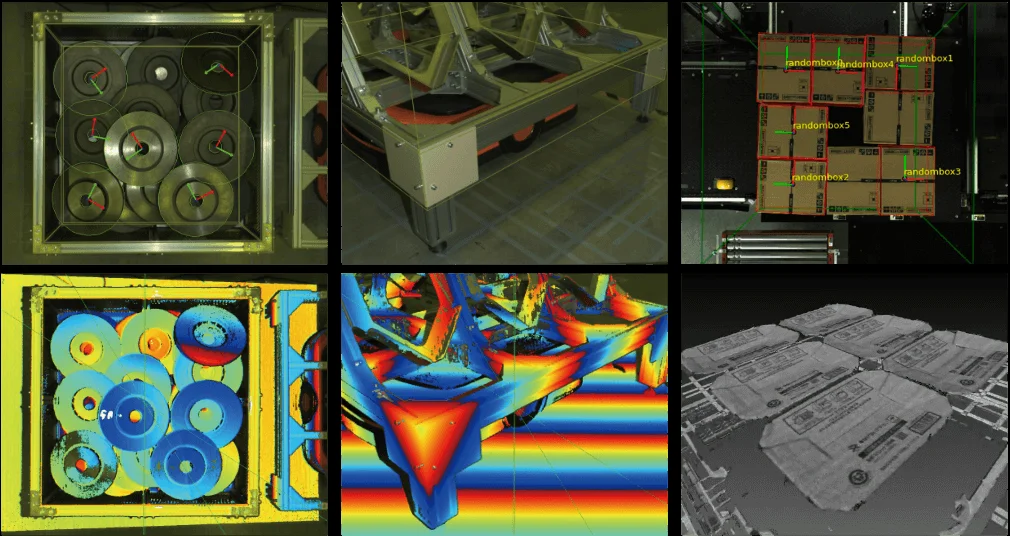
2. The 95% Benchmark and the Critical “Last 5%”
In academic literature and consumer AI benchmarks, achieving a 95% to 98% accuracy rate is universally lauded as a breakthrough.
However, in a high-throughput logistics facility or manufacturing line processing tens of thousands or hundreds of thousands of packages every day, a 5% error rate means thousands of failures every single shift. A robot stopping even once per hour brings the entire automated conveyor network to an abrupt halt, resulting in catastrophic operational losses.
This final 5% can never be bridged by simply collecting thousands more training images or fine-tuning neural network weights. It requires true engineering mastery: solving physical phenomena at the fundamental mathematical and geometric level.
3. Beyond Data Tuning: The Art of Algorithm Development
When standard deep learning systems encounter accuracy drops, the standard industry playbook is repetitive and brute-force: gather more images, manually label bounding boxes, and retrain the model. This workflow hits an insurmountable ceiling in real-world robotics.
Consider this concrete challenge: “How does an autonomous robot safely pick a cardboard carton with a crushed or dented corner?”
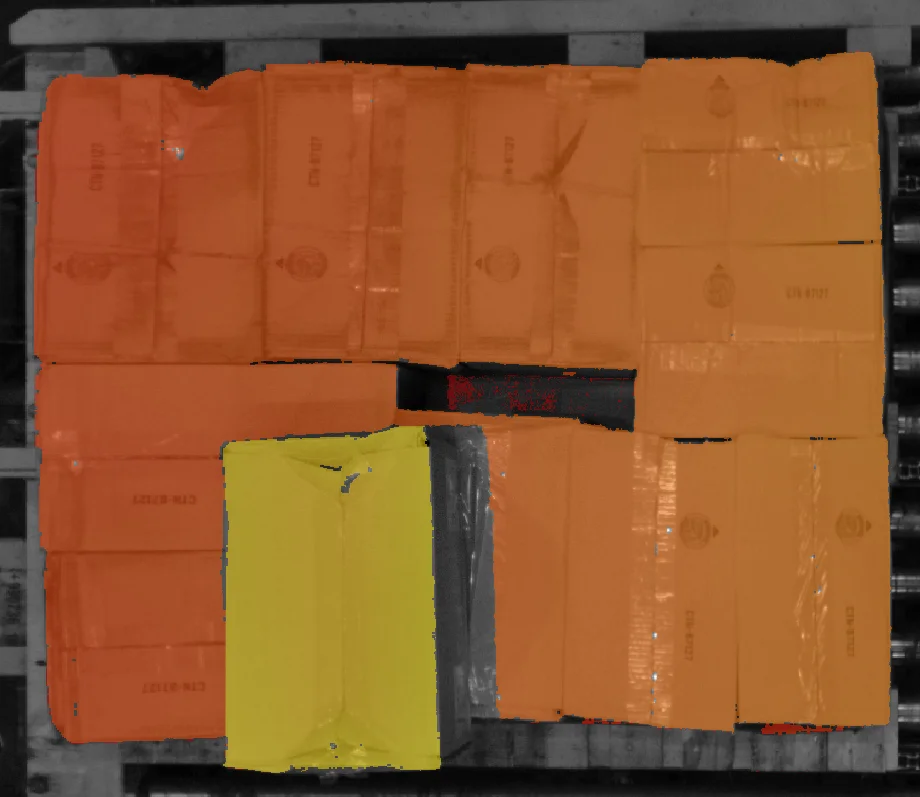
A pure deep learning approach would dictate collecting tens of thousands of images of crushed cartons in every conceivable shape and lighting condition. But no enterprise customer would accept a vendor intentionally destroying hundreds of their valuable products just to build a dataset.
Mujin’s vision engineers approach this challenge analytically:
- Physical Model Formulation: When a carton’s corner buckles, how do surface normal vectors and planar flatness in the 3D point cloud deviate from ideal geometry?
- Vacuum Optimization & Collision Avoidance: If a vacuum suction cup lands on a crease or dent, air leaks and vacuum pressure drops instantly. The algorithm must dynamically relocate the grasp point toward flat, rigid surfaces closer to the calculated center of mass.
- Encoding Domain Knowledge into Algorithms: Instead of blindly increasing training samples, our engineers translate the invariant physical properties of carton deformation into deterministic mathematical algorithms.
This is what we call “The Art of Algorithm Development”—solving real physical challenges through deep algorithmic insight rather than blind parameter tuning.
4. Machine Intelligence Built for the Gemba
In high-volume e-commerce fulfillment, consumers expect their packages to arrive in flawless condition. Torn paper bags, scuffed luxury cosmetic boxes, or ruptured shrink-wrap packaging are completely unacceptable.
Mujin’s 3D vision system autonomously unifies multi-modal intelligence directly at the edge:
- Deformation Tolerance Classification: Instantly determining whether a target SKU is a flexible deformed item (polybag, pouch, folded clothing) or a rigid container (can, bottle, corrugated box).
- Dynamic Approach Vector Calculation: Computing optimal end-effector trajectory angles in real time to prevent collisions with bin walls or adjacent goods.
- Real-Time Grasp Margin Verification: Validating the continuous safety margin between gripper contact zones and SKU orientation before initiating motion.
Because these algorithms are forged through millions of operational cycles on physical industrial robots rather than sanitized desktop simulations, they exhibit unmatched resilience in the harshest industrial settings.
5. Future Outlook: Autonomous Scalability in Vision Engineering
Our ultimate ambition is to liberate vision engineering from the labor-intensive trap of manual data collection, annotation, and parameter tweaking.
By automating feature extraction and embedding geometric constraints directly into machine intelligence architectures, we empower engineers to focus on high-level system design and creative architectural innovation. This leap will allow intelligent robots to scale across global manufacturing and logistics facilities at an unprecedented velocity.
For engineers driven to solve real-world physical challenges with uncompromising technical rigor, Mujin is the world’s most intellectually exhilarating frontier.