---
title: "Inventing Valuable Things with My Own Hands: From Univ. of Tokyo JSK to Mujin – Employee Interview: Integration Engineer"
description: "From the University of Tokyo JSK robotics lab to semiconductor equipment and humanoid robotics, meet Nori. He designed the world's first dual-case depalletizing gripper and Fast Retailing robot cells, explaining the thrill of real-world mechanical integration."
type: blog
publishDate: "2020-02-12"
tags: ["Interview", "Engineering", "Robotics", "Hardware"]
---
Welcome to another edition of our "Mujinians Voice" series!
Today, we interview **Nori**, who works as a Mechanical & System Integration Engineer in Mujin's System Engineering Division.
After graduating from the University of Tokyo's prestigious **JSK Robotics Laboratory (Jouhou System Kougaku)**, Nori gained deep engineering experience at major equipment manufacturers and robotics ventures before joining Mujin. Having engineered the world's first dual-case carton depalletizing gripper and automated robotics cells for Fast Retailing (Uniqlo), Nori shares his passion for translating mechanical concepts into physical production reality.
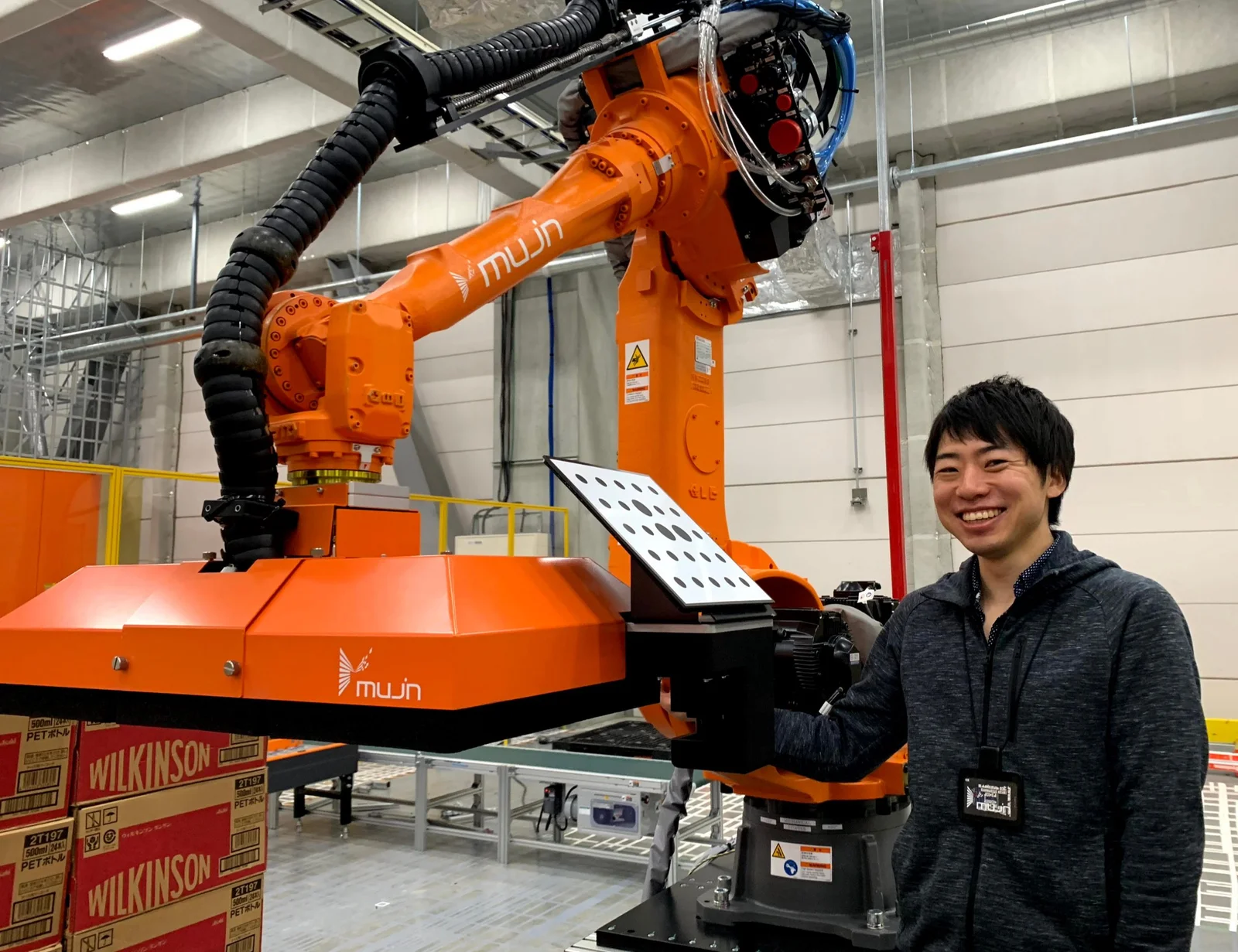
System Engineering Division Mechanical Engineer: Nori
**From JSK to Mechatronics**
"A Robot Must Move"
Researched humanoid kinematics at Univ. of Tokyo JSK. Learned ultra-reliable design in semiconductor tools and industrial humanoid development.
**Dual-Case Gripper Pioneer**
Groundbreaking Mechanical Design
Engineered the world's first dual-carton depalletizing gripper for iREX 2019 and spearheaded mechanical cells for Fast Retailing.
**Meeting the CTO with Bread in Hand**
From Theory to Genuine Impact
Drawn by Mujin's unvarnished culture where engineers and executives casually debate frontline industrial reality over lunch.
---
## 1. Childhood Origins & Univ. of Tokyo JSK: "A Robot Must Move"
*-- How did you first get into engineering and robotics?*
> 💬 **Nori:**
> I've loved building things with my hands since early childhood. My father and I would build wooden decks in the backyard, construct shelves, and tinker with car engines. Through those formative experiences, I dreamed: **"How incredible would it be to make a living creating things that genuinely help people and make them excited?"**
>
> When I entered the University of Tokyo, I intended to specialize in either architecture or mechanical engineering. As I attended lectures and visited labs, I realized architecture leaned heavily toward craftsmanship and art. In contrast, mechanical engineering—especially robotics—was still evolving rapidly, holding boundless potential to introduce unprecedented value to society.
*-- Why did you choose the famous "JSK Robotics Laboratory"?*
> 💬 **Nori:**
> My reason was very straightforward: **"Because their robots were moving the most."**
>
> It sounds simple, but it is fundamental. A robot is only truly a robot if it moves in the physical world and performs real work for human beings. JSK didn't just publish theoretical papers; they were relentlessly focused on physical actuation and real-world implementation. I specialized in mechatronics and hardware, researching novel link kinematics and design methodologies for humanoid robots.
---
## 2. Big Enterprise to Robotics Productization: The Research vs. Industry Gap
*-- What was your career trajectory after graduate school?*
> 💬 **Nori:**
> My primary career criterion was always **"the practical application of robotics and mechatronics."**
>
> I first joined the mechatronics engineering department of a leading semiconductor manufacturing equipment maker. Semiconductor fabrication lines demand the absolute zenith of precision automation. Shaving milliseconds off tact times and driving down system downtime creates millions of dollars in customer value. It was a fantastic environment to master disciplined, ultra-reliable industrial design and high-volume manufacturing practices.
>
> However, after several years, I asked myself what kind of engineer I wanted to be for the rest of my life. The answer was unmistakable: **I wanted to productize real robots.** I transitioned to a robotics venture to lead product planning and mechanical design for industrial humanoids. Visiting customer facilities, gathering technical requirements, and translating them into robust physical hardware was immensely rewarding.
*-- What prompted your transition to Mujin?*
> 💬 **Nori:**
> At my previous company, most clients were corporate research departments or academic institutes. While the technology was fascinating, the products had not yet crossed the chasm into commercially viable, profit-generating operational deployments.
>
> I often wondered: *"How can robotics transcend being a sublime academic novelty and become an accessible, indispensable tool solving urgent industrial shortages?"*
>
> Around that time, I met up for drinks with a JSK senior who was working at Mujin. After hearing my thoughts, he suggested: *"Why don't you drop by our office for lunch sometime?"*
Lunch at Tokyo headquarters: Transparent, spontaneous technical discussions between leadership and engineering
> 💬 **Nori:**
> When I visited Mujin for lunch, I witnessed an astonishing scene.
>
> **CTO Rosen Diankov was standing in the corridor holding a piece of bread, engaged in an intense debate with engineers and sales directors.** They were openly discussing what current robotics technology could achieve versus what factory customers desperately needed on the ground—speaking as naturally and passionately as if they were having an everyday casual chat.
>
> *"Here, people naturally discuss how to build genuinely useful robots as real-world industrial products!"* That scene was the definitive answer to everything I had been searching for. Right then and there, I knew I had to join.
---
## 3. "I'm Really Enjoying It!": 10 Months Packed with 10 Years of Growth
*-- How has your journey at Mujin been so far?*
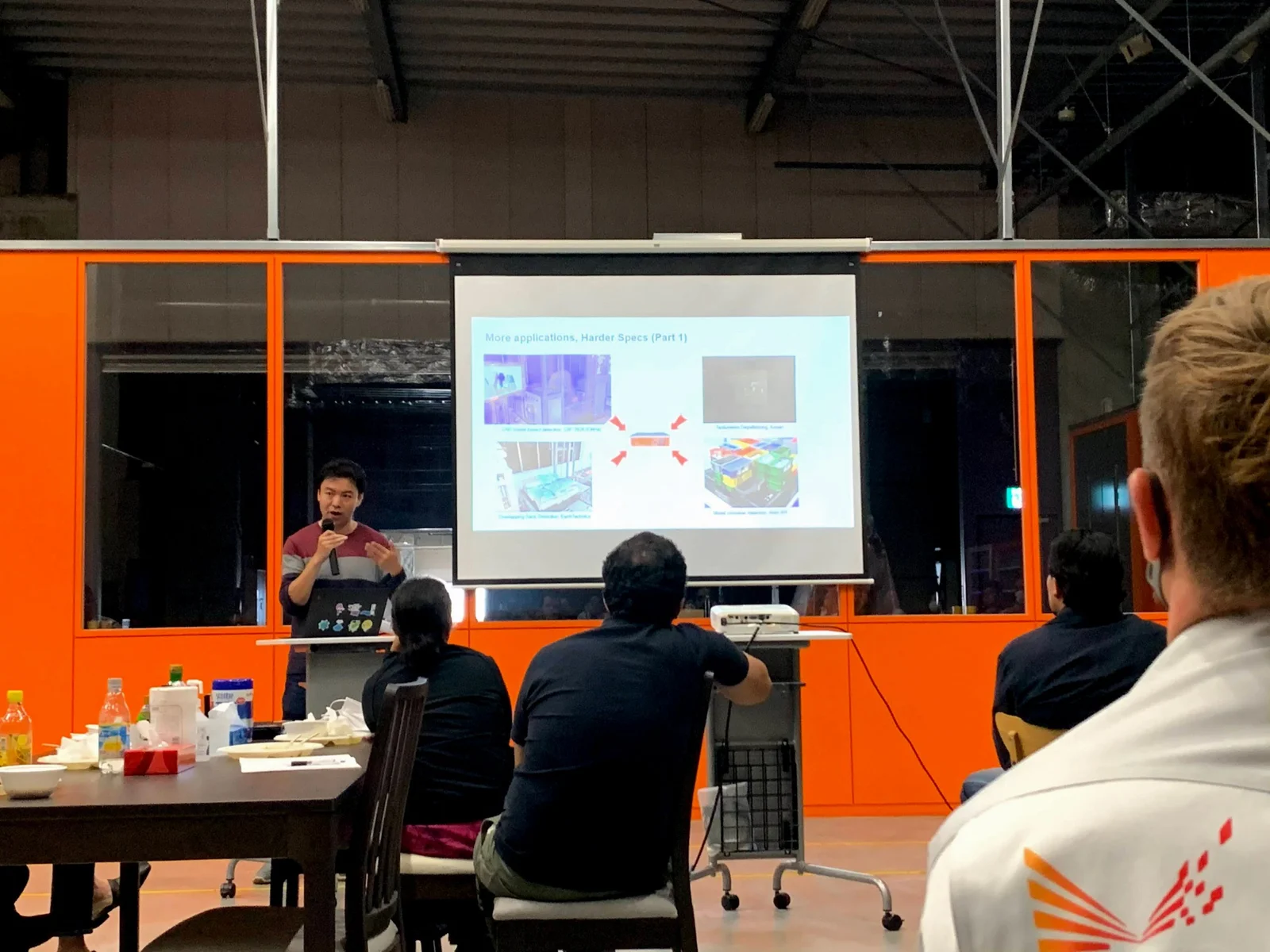
Open collaboration and rapid design cycles across multi-disciplinary teams
> 💬 **Nori:**
> **"I am genuinely having the time of my life!"** (*laughs*).
>
> The hardware, grippers, and robotic cells that I poured hours into designing are running 24/7 inside real client distribution centers and factories across Japan and overseas. Watching our robots operate at high speed via remote monitoring cameras, or hearing client warehouse managers express relief that back-breaking physical labor has been automated away, provides unmatched fulfillment.
>
> What makes Mujin exceptional is that responsibility is granted based purely on ability and initiative. In just 10 months here, **I feel I have accumulated the equivalent of 10 years of experience at a conventional enterprise**.
---
## 4. Mechanical Engineering at Mujin: Dual-Case Grippers & Fast Retailing Cells
*-- What are your core responsibilities within System Engineering?*
> 💬 **Nori:**
> The System Engineering Division is responsible for the end-to-end realization of customer projects: facility layout engineering, mechanical gripper design, robot commissioning, teachingless calibration, and on-site integration.
>
> As a mechanical engineer, my focus is **designing novel robotic end-effectors (grippers) and modular workcell layouts**. From initial concept generation to 3D CAD modeling, rapid prototype machining, pneumatic circuit optimization, and rigorous continuous physical stress testing on actual industrial arms, we control the entire lifecycle.
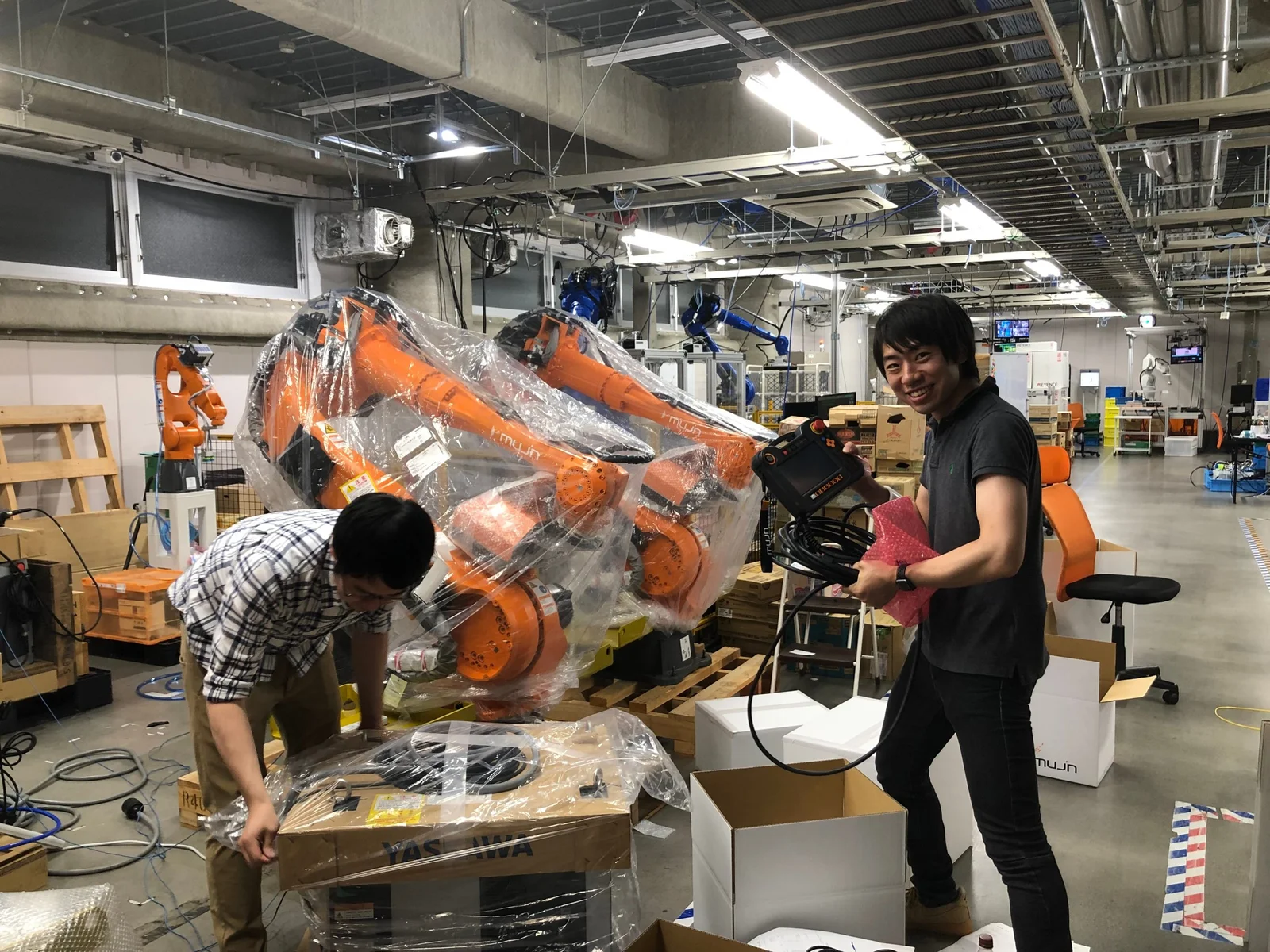
Prototyping advanced vacuum end-effectors at Tokyo Robotics LabThe world's first dual-case depalletizing robot cell demonstrated at iREX 2019
> 💬 **Nori:**
> A major milestone was developing the **world's first dual-carton depalletizing gripper** showcased at the International Robot Exhibition (iREX 2019). While standard industrial depalletizers handle one carton at a time, we engineered an independently actuated vacuum gripper capable of picking two distinct cartons simultaneously, dramatically boosting line throughput.
>
> Furthermore, I led mechanical prototyping, detailed CAD design, and physical validation for the automated **robot cells deployed for Fast Retailing (Uniqlo)**. Seeing our mechanical hardware operating around the clock in one of the world's most advanced apparel supply chain hubs is the ultimate reward for an engineer.
---
## 5. Big Corporate vs. Mujin: Delivering True Technological Impact
*-- Having experienced both large enterprises and Mujin, what advice would you share with engineers?*
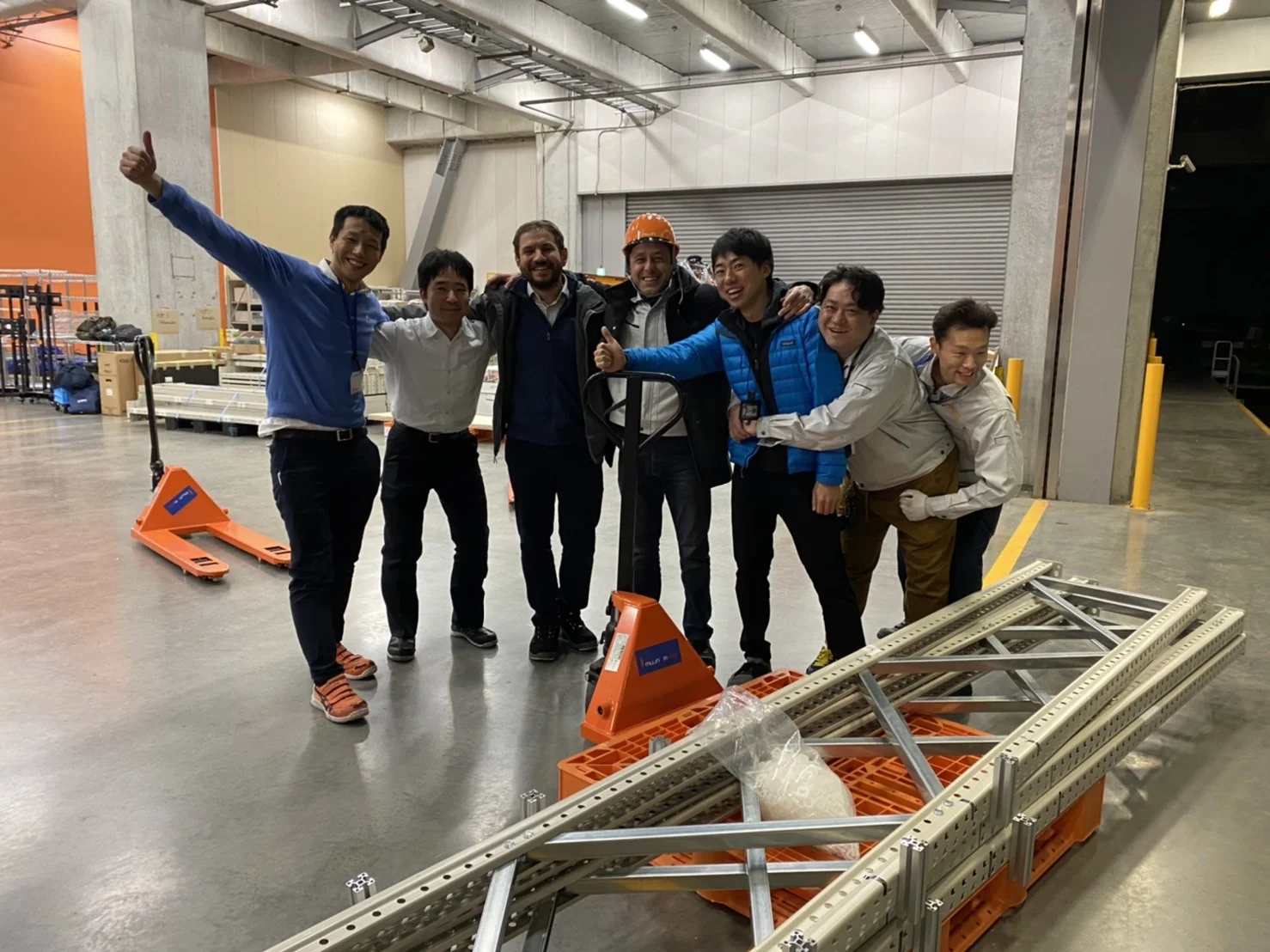
On the frontlines of industrial automation at Mujin's Tokyo Robotics Lab
> 💬 **Nori:**
> Large enterprises offer structured processes and scale, which can be great learning opportunities. However, career advancement in legacy conglomerates often depends more on political maneuvering, presentation formatting, and committee negotiations than on genuine engineering capability.
>
> At Mujin, **technical excellence and tangible real-world results are what matter**. You don't get bogged down in bureaucratic paperwork. You apply your technical abilities directly to physical reality and witness the impact on client factory floors immediately.
>
> If you are driven by the ambition to invent practical tools that transform human society with your own hands, there is no more invigorating company in the world.
>
> Let's shape the automated future together!
---
:::tip[Turn Robotic Concepts into Physical Reality]
Mujin is hiring Mechanical Engineers, Field Integration Engineers, and Robotics System Engineers worldwide.
- Learn about system engineering: [Robotics System Team Overview](/teams/mujin-os/robotics-system)
- Company milestones: [Award History: 28 Major Industry Honors](/blog/award-history)
- Careers portal: [Mujin Careers Portal](https://jobs.lever.co/mujininc)
:::