--- title: "Ace Your Robotics Job Interview at Mujin" description: "How to prepare for Mujin's Robotics interview: real-time motion planning vs. teaching, hands-on technical questions, and the books our team recommends." type: blog mode: center date: "2026-11-09" tags: ["Technology", "Robotics", "Careers", "Engineering"] --- If you are getting ready for a robotics interview, it helps a lot to know what the job actually involves. "Robotics" means very different things at different companies, so in this post we explain what it means for us. At Mujin, the Robotics team owns the robot side of MujinOS from end to end. We get a task like *"depalletize this mixed-SKU pallet"*, and we plan smooth, collision-free motion for industrial arms from many vendors, without any teaching. We also build the rest of what makes a cell run. That includes the integration with vision, the communication with robot controllers, PLCs, conveyors, and sensors, feedback control, the state machines that sequence each cycle and recover from failures, and the handling of orders as they come in. Below we go through what we look for in the technical interview, the fundamentals you will need, and a few questions you can practice with.
We doubled the throughput.
Come help us reach 1,200 and beyond.
1st Generation
~500 cs/h per cell
~7.2s per case
Today · 2×
1,000+ cs/h per cell
~3.6s per case
Next
1,200 cs/h per cell
3.0s per case · We need you
1st Gen · ~500 cases/hour Mixed-case palletizing
Today · 1,000+ cases/hour Mantis Gripper · 2×
Next Target: 1,200+ cases/hour · We need you to help shave the next 0.6s per cycle
Cutting each case from 3.6s to 3.0s without increasing drops or stops takes new motion planning, perception, and control.
Join the Robotics Team
From about 500 to over 1,000 cases per hour per cell. Next we are aiming for 1,200.
--- ## Planning Motion Instead of Teaching Waypoints [#planning-vs-teaching] In industrial automation, how a robot gets its motion fundamentally shapes the engineering challenges you will solve every day. **Traditional Waypoint Teaching** **Mujin Real-Time Motion Planning** :::important[The Core Challenge: High Throughput Meets Near-Zero Error Rate] When a robot moves faster, there is far less margin for perception error, grip slip, and timing jitter. Every fraction of a second we save must come **without** increasing dropped items, collisions, or line stops. ::: --- ## Step 1: Understand the Domain & Specialize Your Preparation [#step-1] "Robotics" covers many kinds of systems, e.g. drones, AGVs, humanoids, and industrial arms. They all move, but the motion problems they solve are quite different. So the first step is to focus your preparation on the kind of robotics you are applying for. **Drones & UAVs** Flight in Open Space
Most of the difficulty is in controlling an underactuated vehicle. Planning is often simpler, since the space is mostly empty and the drone can be treated as a sphere that moves in position plus yaw. **Autonomous Mobile Robots & AGVs** Planar Navigation
Driving on a floor reduces the motion to SE(2), i.e. x, y, and θ. The main topics are localization, SLAM, and navigation. Speed is limited for safety around people, and centimeter accuracy is usually enough. **Humanoids & Mobile Manipulators** Go Anywhere, Do Many Things
A humanoid can both move around and handle things in spaces built for people, and it takes up little floor space. The price is paid in hardware. Small, lightweight motors limit how much it can carry and how fast and precisely it can move. **Industrial Robotic Manipulation (Mujin)** Fast Motion Without Teaching
Industrial arms make the opposite trade. They are bolted to the floor and need a dedicated cell, but their large motors and stiff structure move heavy payloads fast and with sub-millimeter repeatability. Our job is to turn that hardware into throughput. The motion is computed from the current scene with no teaching, in a cluttered cell, close to the robot's limits, and in sync with vision and conveyors, 24/7.
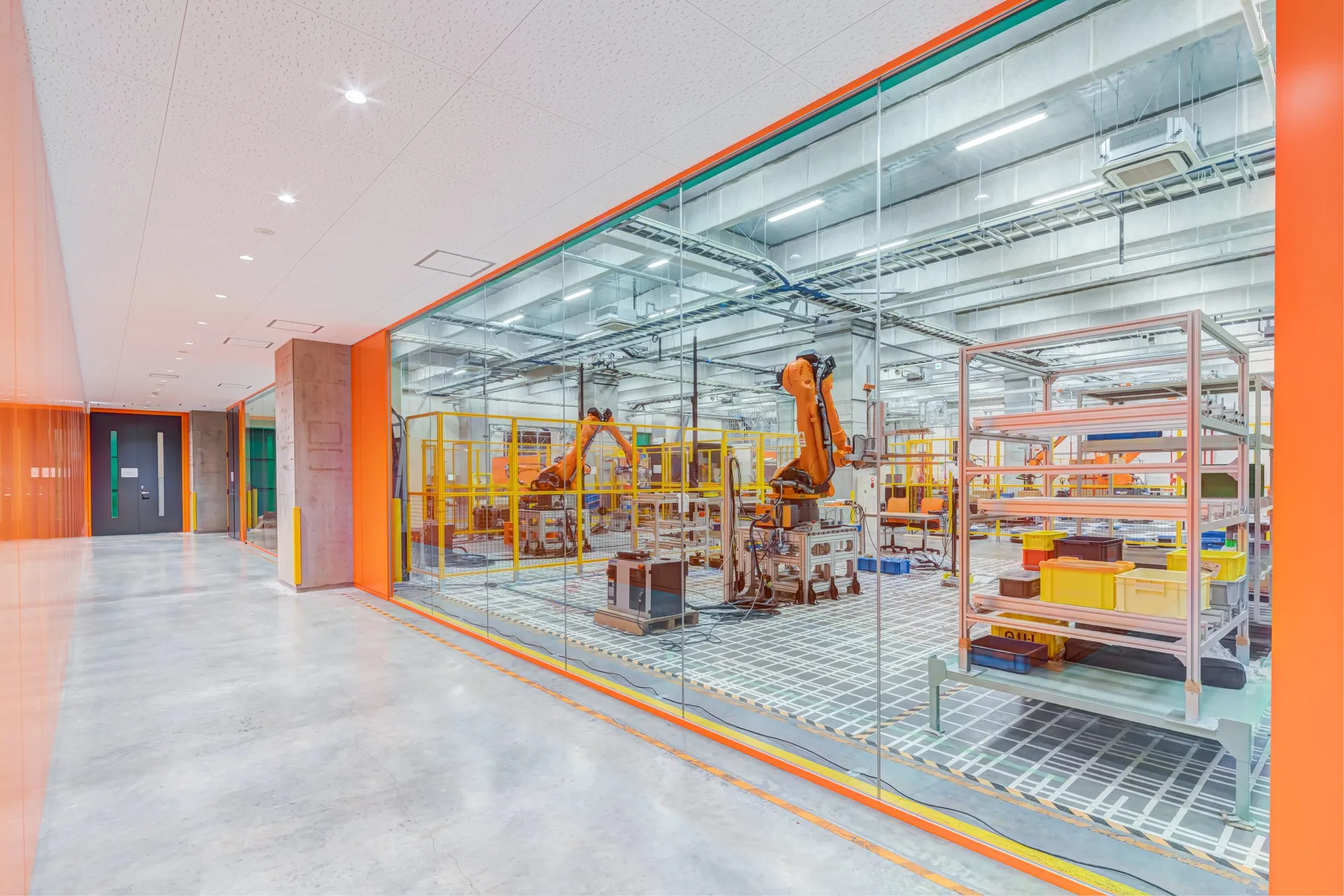
--- ## Step 2: Know What to Expect in Mujin’s Technical Interview [#step-2] Our technical interview is about practical, hands-on engineering. We want to see how you use the fundamentals to work through real problems, so there is little point in memorizing formulas. Hardware-in-the-loop industrial robot test cell inside Mujin Tokyo HQ From the whiteboard to the test cell, we look at how you apply core computer science to robots running in production **1. C++ & Python** Solid C++, including memory and pointer safety, performance debugging, and concurrency. We also use Python a lot, mostly to coordinate tasks and to write test harnesses. **2. Applied Math & Geometry** Being comfortable with linear algebra, SE(3) transforms, quaternions, Jacobians, forward and inverse kinematics and dynamics, and some basic computational geometry. **3. Software That Moves Real Machines** Writing code that controls real hardware. That means meeting real-time deadlines, avoiding race conditions between threads and devices, and staying within joint velocity, acceleration, and torque limits. It also means using sensor feedback to adapt the motion, and recovering from failures without stopping the line. --- ## Step 3: Practice with Deep-Dive Technical Questions [#step-3] These questions are similar to the ones we discuss in our interviews. Many of them are open-ended, so talk us through your reasoning. Asking clarifying questions and stating your assumptions are part of a good answer.

Question 1: The camera sees an object. Where should the robot’s gripper go to grasp it?

Key insight: Most mistakes happen before IK even starts. People multiply the transforms in the wrong order, or use a transform in the wrong direction (e.g. T_cam_base instead of T_base_cam). Once the target pose is right, the next step is inverse kinematics, which usually has more than one solution.